
Post
Ray-Ban Aviator Classic RB3025: The Original Icon That Defined Sunglass History
May
Ray-Ban Aviator Classic RB3025: The Original Icon That Defined Sunglass History
There is a brief list of product designs that have so completely defined their category that the category and the design have become effectively synonymous in the public imagination. The Ray-Ban Aviator belongs on this list without qualification. Created in 1937 for the United States Army Air Corps as functional protective eyewear for military pilots, the Aviator has accumulated nearly nine decades of continuous production, cultural adoption by successive generations, and the kind of design legacy that no amount of marketing investment can manufacture—it can only be earned through genuine quality and enduring relevance. The Aviator is more than a sunglass; it is a piece of American history, a symbol of adventure and heroism that has transcended its original purpose to become a timeless fashion staple.
The Military Origin Story
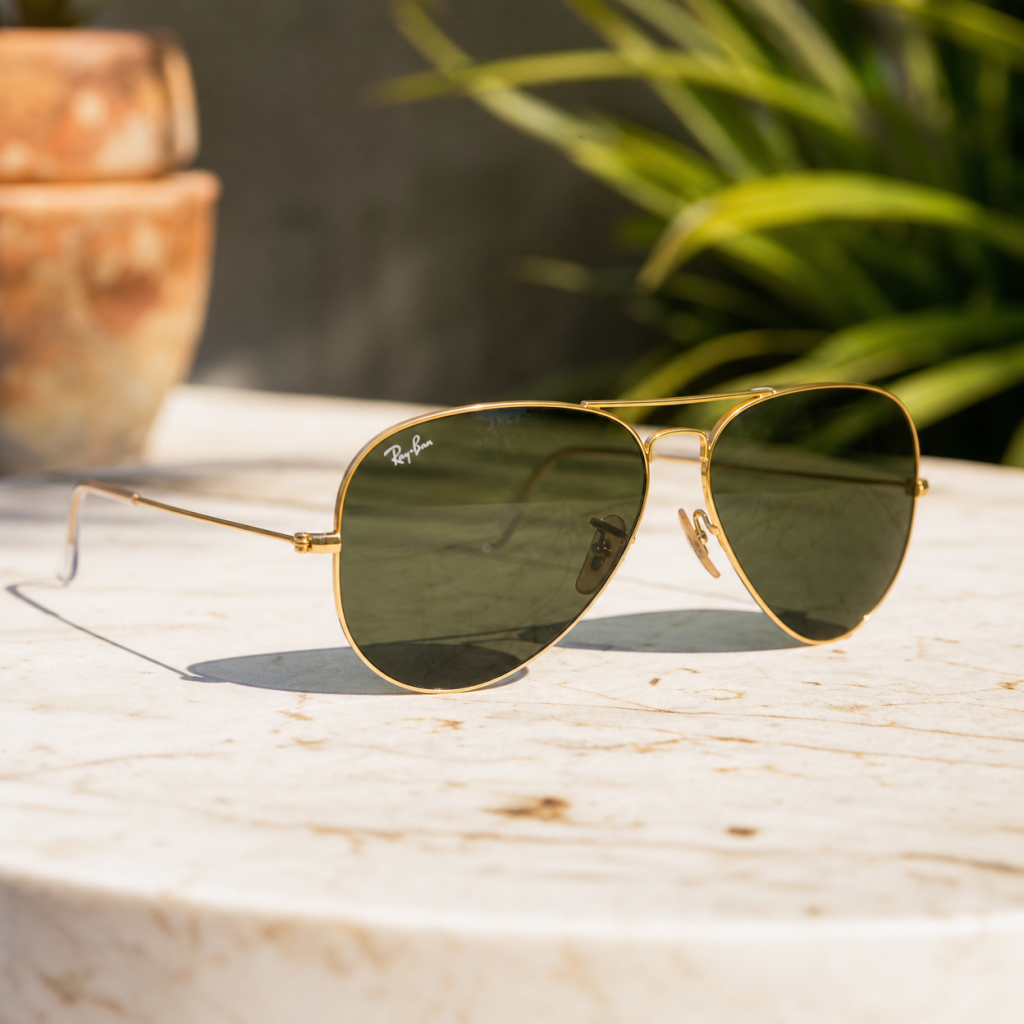
The Aviator’s original specifications were determined by the practical requirements of military aviation rather than aesthetic considerations. Pilots needed eye protection that covered as much of the visual field as possible—hence the large, teardrop-shaped lens profile that sweeps down below the natural eye position to protect against glare from below as well as above. The thin metal frame was chosen for its combination of strength and low weight, and the double bridge—the distinctive dual bar that connects the two lenses—was an engineering decision that provided additional structural rigidity without adding significant weight. Every design element served a clear purpose. The G-15 lens tint, another Aviator signature, was developed through laboratory research into the optimal combination of light reduction and color accuracy for aviation use. The grey-green formulation reduces brightness while maintaining natural color perception—critically important for pilots who needed to accurately judge the colors of signal lights, terrain features, and weather conditions. This functional excellence translated seamlessly to recreational and fashion use when the Aviator transitioned from military to civilian distribution. The same qualities that made it perfect for pilots made it perfect for anyone spending time outdoors.
Cultural Journey: From Cockpits to Cultural Icons
The Aviator’s transition from military issue to cultural phenomenon began in earnest in the post-World War II period, when returning servicemen who had worn the glasses during their military service continued to use them in civilian life, creating a first wave of civilian adoption. The design’s association with the romance and heroism of aviation gave it a powerful aspirational quality that resonated with a generation for whom aviation represented freedom, adventure, and technological mastery. Subsequent decades brought successive waves of Aviator adoption that cemented its status across generations. The 1970s counterculture embraced the design as a signifier of anti-establishment cool. The 1980s saw it become associated with the aspirational masculinity of films like Top Gun, which remains one of the most commercially significant product placements in advertising history. The 1990s and 2000s saw its adoption by the hip-hop community, and subsequent decades have seen the design embraced by fashion-conscious wearers of all genders and backgrounds as an unambiguously classic choice. The Aviator has proven its ability to adapt to and define the style of every era.
The G-15 Lens: Understanding the Science
Ray-Ban’s G-15 lens remains the most scientifically credentialed sunglass lens available in the mainstream market, with a development history that spans eight decades of refinement and testing. The grey-green tint reduces visible light transmission to approximately 15% of incident light—hence the “15” in the designation—while the grey-green color formulation maintains the relative intensity relationships between different spectral colors rather than selectively enhancing or suppressing specific wavelengths. This spectral neutrality is the G-15’s most important practical characteristic: it means that the world seen through G-15 lenses looks like the real world with the brightness turned down, rather than looking through a colored filter that distorts color relationships. For everyday use, this translates to comfortable, natural-looking vision without the color distortion that strongly tinted lenses impose. The UV400 blocking of G-15 lenses provides complete protection against both UVA and UVB radiation across the 400nm cutoff that corresponds to the boundary between ultraviolet and visible light. Your eyes are protected without any compromise in visual quality.
Frame Construction and Material Quality
The RB3025 Aviator frame is constructed from a lightweight metal alloy—specifically, a gold-filled or silver alloy in the standard versions, with various plated finishes in the expanded color range. The metal construction gives the frame a natural temperature feel that many wearers prefer to the warmth of acetate, and provides a durability advantage in the thin frame sections of the double bridge and temple arms that would be challenging to achieve in plastic materials. The thin wire frame is deceptively strong. The cable-style temples of the original military design have been replaced in the current RB3025 with conventional spatula temples in most configurations, though the cable temple style remains available as an option for wearers who prefer the adjustable, secure fit of the wrapped cable design. Adjustable nose pads allow precise positioning of the frame on a wide range of nose shapes. This thoughtful adjustability ensures that the Aviator can be tailored to fit almost anyone perfectly, enhancing both comfort and optical performance.
Polarized Lens Options
Ray-Ban offers the Aviator RB3025 with polarized lens options in addition to the standard G-15 and various other tints. Polarized lenses provide an additional layer of glare reduction beyond simple tinting by selectively blocking horizontally polarized light—the specific orientation of reflected glare from flat surfaces including water, roads, and automobile hoods. For wearers who drive frequently or spend time near water, polarized Aviator lenses transform the glare reduction performance from excellent to exceptional. The reduction in eye strain is immediately noticeable. The polarized option maintains the classic G-15 color signature while adding this powerful glare-cutting capability, making it the ideal choice for pilots, drivers, fishermen, and anyone who spends significant time in bright, reflective environments. It is the best of both worlds: iconic style with cutting-edge performance. With polarized Aviators, you see the world more clearly and comfortably.
Sizing Options and Face Compatibility
The RB3025 is available in three lens widths: 55mm, 58mm, and 62mm, providing options for small, medium, and large face sizes respectively. This range ensures that there is an Aviator for almost every face. The large teardrop lens shape is broadly compatible with most face shapes, with particular flattery for square faces where the curved lower lens edge softens the angular jawline. Round faces benefit from the frame’s horizontal double bridge, which adds visual width to balance the face’s circular geometry. The Aviator’s universal appeal is one of the keys to its enduring success. Trying on different sizes is recommended to find the perfect fit, as the right size will sit comfortably and look balanced on your face. An experienced optician can help you determine which lens width is best suited to your facial proportions.
Caring for Your Aviator Legacy
Given the iconic status and potential longevity of the Ray-Ban Aviator, proper care is essential. Always clean the lenses with the included microfiber cloth, using a lens cleaner specifically formulated for coated lenses. Avoid using paper towels or clothing, which can scratch the delicate lens surfaces. Store your Aviators in their hard-shell case when not in use to prevent scratches and bending of the thin metal frame. Periodically check the nose pads and hinges for any signs of looseness, and have them tightened by a professional if necessary. With proper care, a pair of Aviators can last for decades, becoming a cherished part of your personal style. They are an heirloom-quality item that can be passed down through generations.
Conclusion: An Enduring Symbol of Cool
The Ray-Ban Aviator Classic RB3025 occupies a unique position in the history of consumer product design: it is a working tool that became an art object, a military specification that became a cultural symbol, and a fashion item that has maintained its relevance not through reinvention but through the simple, enduring quality of its original design. Buying an Aviator in 2026 connects you to a lineage of wearers that stretches back to the cockpits of the Second World War—and the glasses are genuinely excellent enough to deserve that purchase on entirely practical grounds. They are an investment in timeless style, superior eye protection, and a piece of living history. Slip on a pair of Aviators and become part of the legend.
