Post
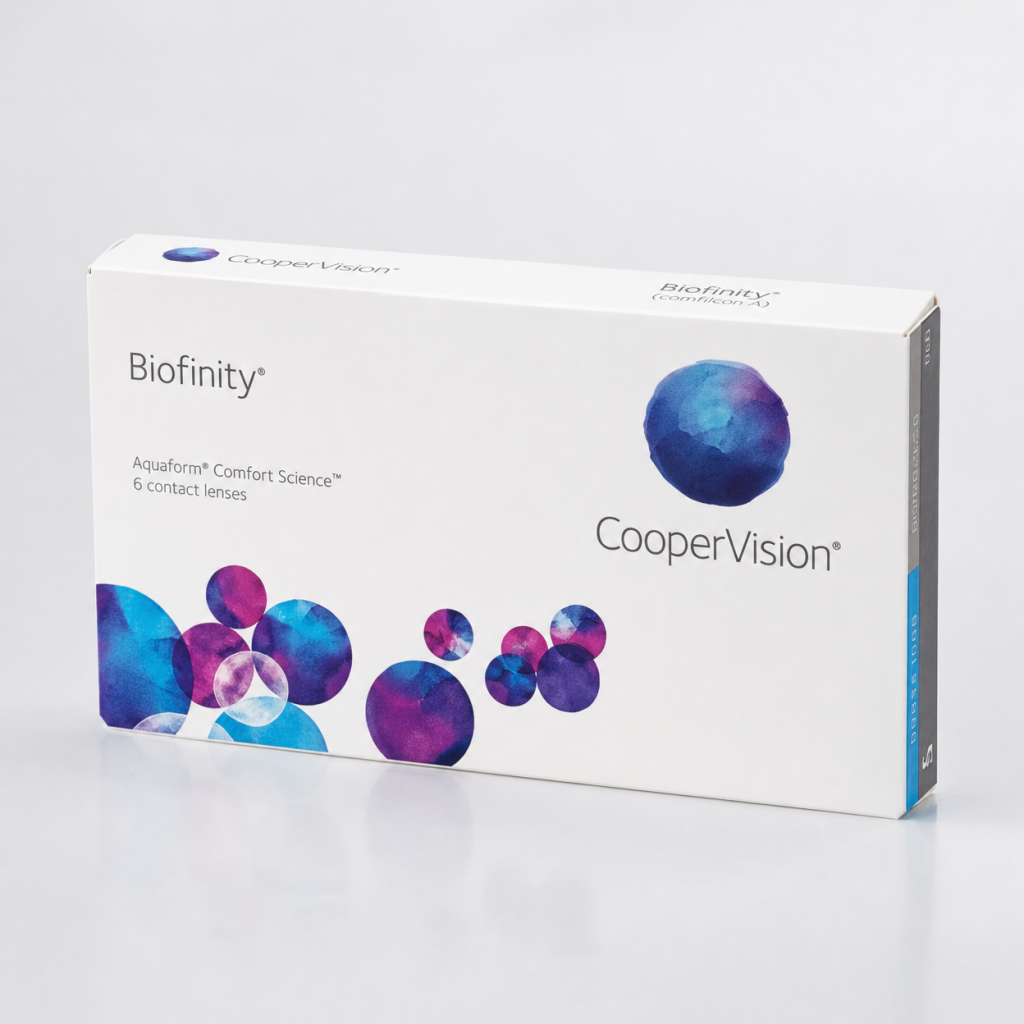
Biofinity Monthly Contact Lenses: The Definitive Monthly Replacement Solution
May
Biofinity Monthly Contact Lenses: The Definitive Monthly Replacement Solution
In the contact lens market, monthly replacement lenses occupy a middle ground between the maximum convenience of daily disposables and the long replacement cycles of quarterly or annual lens designs that were common in the industry’s earlier years. Within this monthly replacement category, CooperVision’s Biofinity has achieved a dominant position that reflects genuine technical leadership: the Aquaform Technology underlying the Biofinity design represented a meaningful advance in silicone hydrogel material science when it was introduced, and subsequent competitive development has not substantially narrowed the performance advantage that technology provides. For wearers who prefer the economics of monthly replacement—fewer lenses purchased per year, though with the added responsibility of daily cleaning and disinfection—Biofinity offers a combination of comfort, oxygen performance, and visual clarity that has made it one of the most prescribed contact lenses in the world. It is the monthly lens that other monthly lenses aspire to be.
Aquaform Technology: The Chemistry of Comfortable Silicone Hydrogel
When silicone hydrogel contact lens materials were first developed and commercialized in the late 1990s, they represented a significant advance in oxygen transmissibility over conventional hydrogel materials. However, the first generation of silicone hydrogel lenses faced a significant practical limitation: the silicone component, while oxygen-permeable, was inherently hydrophobic—repelling rather than attracting water. This surface hydrophobicity caused comfort problems, as the silicone-rich lens surface was not naturally wettable and tended to attract lipid deposits from the tear film that further compromised comfort over the wearing period. First-generation silicone hydrogel manufacturers addressed this problem by applying surface treatments—plasma oxidation or surface grafting processes that modified the outermost layer of the lens to create a more hydrophilic surface character. While effective initially, these surface treatments had finite durability and could degrade over the wearing period, contributing to the comfort reduction that many wearers noticed in the second and subsequent weeks of a monthly replacement cycle. CooperVision’s Aquaform Technology took a fundamentally different approach: rather than treating the surface to overcome inherent hydrophobicity, the Aquaform chemistry creates a silicone hydrogel material that is inherently wettable throughout its entire composition. The polymer chains in comfilcon A (the Biofinity lens material) are engineered to incorporate hydrophilic segments that distribute uniformly throughout the material thickness, creating a wettable surface that does not depend on surface treatments and therefore does not degrade over the wearing period. This inherent wettability means that Biofinity lenses remain comfortable not only through the wearing day but through the entire monthly replacement cycle, without the progressive comfort decline that affects many competing monthly lenses.
Extended Wear Capability
The Biofinity’s comfilcon A material achieves a Dk/t (oxygen transmissibility) of 160 Barrer/cm—significantly exceeding the threshold of approximately 125 Barrer/cm that has been established as necessary for safe overnight wear in most patients. This high oxygen transmissibility has supported FDA approval of the Biofinity for up to six nights of continuous wear (eyes closed during sleep), making it a genuinely capable extended wear option for patients whose lifestyle or medical circumstances make continuous wear desirable. The clinical significance of this approval cannot be overstated: most monthly lenses do not achieve the oxygen transmissibility required for FDA-approved extended wear, and those that do often require more frequent replacement or have higher rates of adverse events. Biofinity’s combination of high Dk/t and inherent wettability provides a safety and comfort profile that supports extended wear for appropriate patients. It is important to emphasize that extended wear should only be undertaken following consultation with and approval by an eye care professional, as individual patients vary significantly in their physiological responses to closed-eye lens wear and not all patients are suitable candidates for this modality. Factors such as baseline tear production, eyelid anatomy, and history of ocular infections all influence the risk-benefit calculation for extended wear. However, for appropriate patients under professional supervision, the Biofinity’s oxygen transmissibility provides the physiological foundation for safe extended wear use, offering the convenience of continuous vision correction for up to a full week at a time.
Balanced Water Content and Stability
The Biofinity maintains a water content of 48%—a formulation balance that reflects careful optimization between comfort, oxygen transmission, and dimensional stability. Higher water content materials tend to dehydrate more readily during wear (as the lens loses water to the environment through evaporation and the mechanical action of blinking), which can paradoxically lead to greater end-of-day dryness despite the higher initial water content. Lower water content materials, by contrast, may feel drier initially despite lower dehydration rates, as the lower water content provides less immediate hydration to the lens surface. The 48% balance of the Biofinity achieves a comfortable initial feel while maintaining dimensional stability throughout the wearing day, ensuring that the lens retains its shape and optical precision even after many hours of wear. This stability is particularly important for patients with astigmatism, where even small changes in lens geometry can affect rotational stability and visual clarity. The Biofinity’s balanced water content also contributes to its deposit resistance, as the material’s surface chemistry and water content create an environment that is less attractive to tear film proteins and lipids than either very high or very low water content alternatives.
Product Range Extensions: Toric and Multifocal Options
The Biofinity platform has been extended to address the two largest specialty contact lens populations: astigmatism correction and presbyopia management. Biofinity Toric uses a unique optical zone design and stabilization approach that provides stable, consistently clear vision for patients with astigmatism, addressing one of the contact lens categories where patient dissatisfaction has historically been highest due to rotation stability challenges with alternative designs. The toric lens incorporates a prism ballast stabilization system that uses gravity and the interaction between the lens and the eyelid to maintain consistent rotational orientation, ensuring that the cylinder correction aligns precisely with the patient’s corneal astigmatism axis. Biofinity Multifocal uses CooperVision’s Balanced Progressive Technology to provide clear vision at multiple distances simultaneously, using the brain’s natural neural adaptation to process inputs from different lens zones for near, intermediate, and distance vision. The design’s success rate in clinical fitting has established it as one of the preferred multifocal lens options among eye care professionals globally, with particularly strong performance in patients who have moderate to high add powers. Both the toric and multifocal variants maintain the core Aquaform Technology and comfilcon A material of the standard Biofinity, ensuring that specialty patients receive the same comfort and oxygen performance benefits as spherical wearers.
Economic Considerations
Monthly replacement lenses represent a different economic model from daily disposables: a higher per-lens purchase price offset by the much lower number of lenses consumed annually (24 lenses per year versus 730 for daily disposable wearers). For patients who wear their lenses five to seven days per week and who are diligent about cleaning and disinfection, this economic calculus strongly favors monthly replacement, with annual costs often 40-60% lower than daily disposable alternatives. The addition of care solution costs must be factored into this comparison, as monthly replacement lenses require daily cleaning and disinfection with multi-purpose solution or hydrogen peroxide systems. However, even accounting for solution costs, the monthly replacement model typically remains more economical than daily disposables. Biofinity’s durability and deposit resistance further enhance its economic value, as the lenses maintain their performance throughout the full month of wear, reducing the likelihood of early replacement due to comfort or clarity issues. For patients who find the economics of daily disposables prohibitive but who still want the benefits of silicone hydrogel oxygen performance, Biofinity represents the optimal balance of cost and quality.
Conclusion: The Monthly Market Leader
The CooperVision Biofinity has earned its position as one of the world’s most widely prescribed monthly contact lenses through the genuine performance advantages of Aquaform Technology, the versatility of the product range across prescription types, and the clinical evidence base that supports its safety and efficacy in regular and extended wear conditions. For patients who prefer the economics of monthly replacement over daily disposables and seek the highest available comfort performance in their replacement schedule, the Biofinity represents the most thoroughly validated option in the market. It is the monthly lens that eye care professionals trust for their own use and recommend to their most demanding patients—a testament to its genuine quality and performance superiority.
