Post
Dailies Total1 Water Gradient Lenses: Revolutionary Surface Technology for Invisible Comfort
May
Dailies Total1 Water Gradient Lenses: Revolutionary Surface Technology for Invisible Comfort
Contact lens comfort innovation has historically followed a relatively predictable pattern: improvements in bulk material properties—higher water content, higher oxygen transmissibility, better deposit resistance—delivered through incremental refinements of existing material chemistry. The Alcon Dailies Total1 broke this pattern entirely by introducing a fundamentally different approach to the contact lens comfort problem: a water gradient structure that creates a lens with a completely different material composition at its surface than at its core. This structural innovation, rather than a bulk material improvement, represents the most significant advance in contact lens technology of the past two decades, creating a wearing experience that many wearers describe as transformative. For those who have tried other daily disposables and still found themselves aware of the lens on their eye throughout the day, the Dailies Total1 offers something genuinely different: a lens that feels like nothing at all.
The Water Gradient Concept Explained
In every conventional contact lens—silicone hydrogel or conventional hydrogel—the material composition is essentially uniform throughout the lens thickness. The bulk properties of the material determine both the oxygen transmissibility (which depends on the bulk silicone content in silicone hydrogels) and the surface wettability (which depends on the surface characteristics of the same material). This uniform composition creates an inherent trade-off: materials with excellent oxygen permeability (high silicone content) tend to have hydrophobic surfaces that require treatment or modification to become wettable, while materials with excellent inherent wettability (high water content hydrogels) have low oxygen transmissibility that can compromise corneal health during extended wear. The water gradient lens breaks this constraint by using a material with different composition at different depths through the lens thickness. The core of the Dailies Total1—the kalifilcon A silicone hydrogel—provides high oxygen transmissibility (Dk/t of 156) appropriate for healthy all-day wear, ensuring that the cornea receives adequate oxygen even during long wearing sessions or in reduced oxygen environments. But as the material composition transitions toward the lens surface, the water content increases continuously until it reaches approximately 80% at the very surface of the lens—a water content that approaches that of the natural corneal epithelium and creates a surface that interacts with the tear film in a fundamentally different way than conventional lens materials. At 80% water content, the surface of a water gradient lens essentially feels like touching water rather than plastic. This is not merely a marketing metaphor—it reflects a genuine physical reality that wearers consistently report experiencing when first wearing water gradient lenses: the sensation of the lens on the eye is dramatically different from conventional lens designs, to the point that many first-time wearers of Dailies Total1 describe the experience as “wearing nothing.” The mechanical friction between the lens surface and the eyelid during blinking is dramatically reduced, eliminating the primary source of lens awareness and end-of-day discomfort.
SmarTears Technology and Tear Film Interaction
The Dailies Total1 incorporates an additional comfort technology called SmarTears, in which phospholipid molecules—chemical compounds that are natural components of the lipid layer of the human tear film—are embedded in the lens material and released gradually during wearing. As these phospholipids are released, they integrate into the lipid layer of the tear film, helping to stabilize and maintain the tear film structure over the wearing day. The lipid layer is the outermost component of the tear film, serving as a barrier that reduces evaporation of the underlying aqueous layer and maintains the smooth optical surface required for clear vision. In many contact lens wearers, the lipid layer is disrupted or thinned, leading to increased evaporation and the development of evaporative dry eye symptoms. This stabilization of the lipid layer has particular significance for wearers who experience evaporative dry eye—a condition in which the tear film evaporates too rapidly due to inadequate or impaired lipid layer function. Evaporative dry eye is extremely common among contact lens wearers and is the primary mechanism underlying the end-of-day dryness and discomfort that many wearers experience, affecting up to 50% of contact lens users to some degree. By supplementing the lipid layer, SmarTears technology addresses this mechanism directly, providing ongoing stabilization of the tear film throughout the wearing period and reducing the progressive increase in dryness that many wearers notice as the day progresses.
Optical Performance of the Water Gradient Design
The water gradient structure of the Dailies Total1 presents unique optical considerations. The progressive variation in water content through the lens thickness creates a corresponding gradient in refractive index—a potential source of optical aberration if not carefully controlled, as light passing through a material with varying refractive index can be bent in unpredictable ways. Alcon’s optical engineering team has addressed this challenge through precision control of the gradient profile, ensuring that the optical zone of the lens (the central area through which vision correction is provided) maintains the refractive consistency required for clear, accurate vision correction despite the gradient structure. The result is a lens that provides visual performance equivalent to or better than conventional daily disposable lenses, with no perceptible degradation in image quality or contrast sensitivity. The optical precision of the Dailies Total1 has been validated in numerous clinical studies, demonstrating that the water gradient design does not compromise the visual performance that wearers expect from premium daily disposable lenses. For patients who require sharp, consistent vision for driving, reading, or professional activities, the Dailies Total1 delivers without compromise.
Clinical Evidence and Patient Selection
The Dailies Total1 has accumulated an extensive clinical evidence base since its commercial introduction in 2011—an evidence base that consistently demonstrates superior comfort performance compared to alternative daily disposable designs, particularly in the late-day wearing period when lens-related dryness and discomfort are typically most pronounced. Studies specifically examining wearers with symptoms consistent with dry eye have shown particularly strong comfort performance for the Total1 in this population, with many patients who had previously discontinued contact lens wear due to discomfort able to achieve comfortable full-day wear with the water gradient design. The clinical data suggest that the Total1’s comfort advantage is most pronounced in the final four to six hours of a typical wearing day—precisely the period when conventional lenses often become uncomfortable and when many wearers find themselves reaching for rewetting drops or removing their lenses early. For patients who have struggled with end-of-day discomfort with other daily disposable lenses, the Dailies Total1 offers a clinically validated solution. The lens is particularly well-suited to patients with moderate dry eye symptoms, those who spend extended hours in air-conditioned or heated environments, and those who use digital devices extensively, all of which are situations that exacerbate lens-related dryness with conventional materials.
Prescription Availability and Options
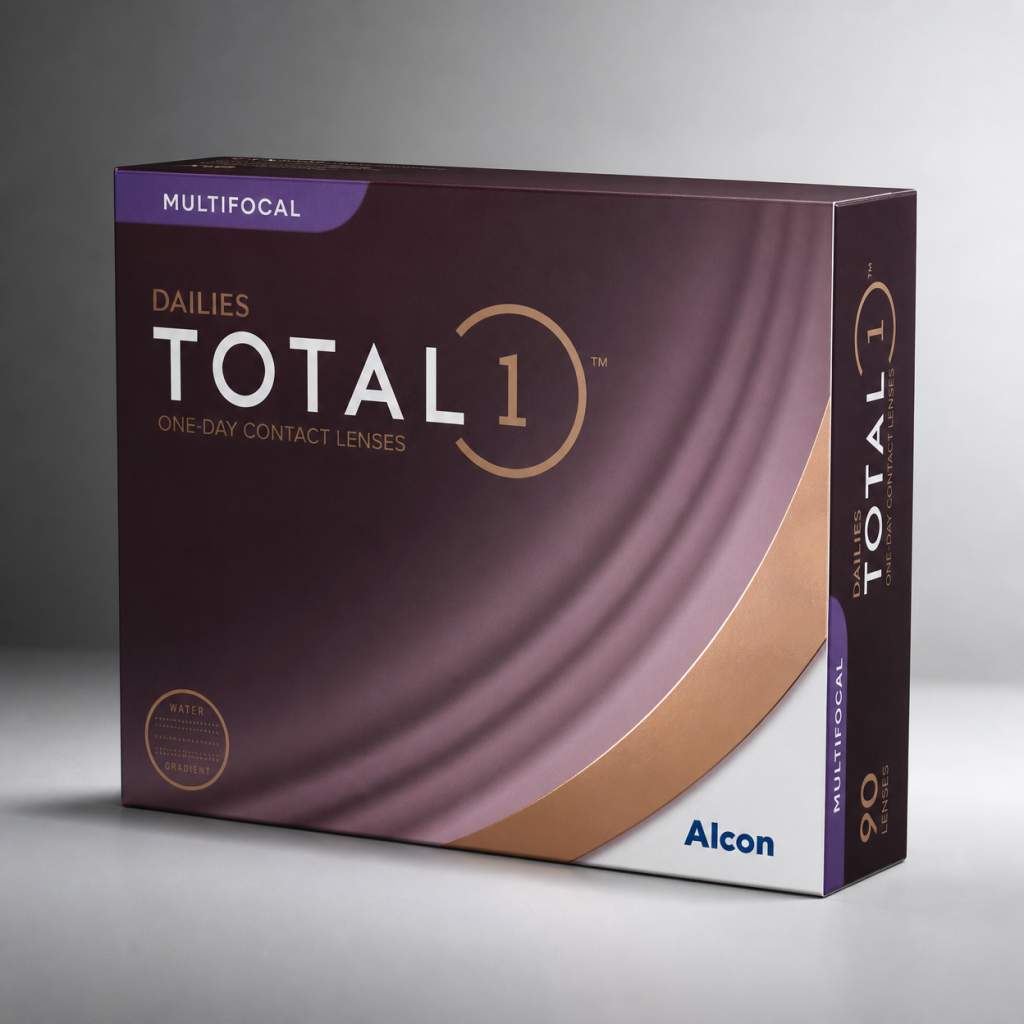
The Dailies Total1 is available in sphere prescriptions from +6.00 to -10.00 diopters, covering the majority of myopic and hyperopic patients seeking daily disposable correction. The Dailies Total1 Multifocal addresses the presbyopic population with a design that has received consistent positive clinical reviews for the quality and consistency of vision it provides at near and distance simultaneously. The multifocal design uses an aspheric center-distance approach with a progressive power profile that provides a smooth transition between focal zones, minimizing the visual disturbances (such as halos or ghosting) that some multifocal wearers experience with less sophisticated designs. For astigmatic patients, the Dailies Total1 for Astigmatism extends the water gradient comfort to toric correction, using Alcon’s precision stabilization system to maintain consistent rotational alignment. This comprehensive range of options ensures that the revolutionary comfort of water gradient technology is available to the vast majority of contact lens candidates, regardless of their specific correction needs.
Conclusion: A Paradigm Shift in Lens Comfort
The Alcon Dailies Total1 represents a genuine paradigm shift in daily disposable contact lens design—not an incremental improvement on existing technology but a structural innovation that creates a fundamentally different wearing experience. For contact lens wearers who have struggled with end-of-day dryness, discomfort during extended wear, or the general sensation of lens awareness throughout the day, the Dailies Total1 offers a solution that has changed the wearing experience for many patients who had previously considered discontinuing contact lens wear. It is among the most clinically significant contact lens introductions in the history of the category, and it remains the benchmark against which other daily disposable lenses are measured for comfort performance. Experience the difference of water gradient technology and discover what invisible comfort truly means.
