Post
Best Mykita Mylon Peet 2026: The Future of Eyewear Manufacturing in 3D-Printed Form
May
Mykita Mylon Peet: The Future of Eyewear Manufacturing in 3D-Printed Form
The eyewear industry has spent decades perfecting manufacturing processes originally developed in the mid-twentieth century—acetate pressing, metal fabrication, injection molding. Mykita’s Mylon collection challenges this convention by applying selective laser sintering, a form of industrial 3D printing, to the production of prescription eyewear frames.
The result is not merely a novelty but a genuinely superior product in specific performance categories—one that demonstrates how emerging manufacturing technologies can create possibilities that conventional methods simply cannot achieve. This is not just a new frame; it is a new way of thinking about what eyewear can be. The Mykita Mylon Peet represents a bold leap into the future, embracing cutting-edge technology to deliver an unprecedented combination of lightness, strength, and design freedom.
What Is Selective Laser Sintering?
Selective laser sintering (SLS) is an additive manufacturing process in which a precisely controlled laser beam sinters—partially fuses—fine powder particles layer by layer to build up a three-dimensional object from a digital model. Unlike traditional subtractive manufacturing, which removes material from a larger block to reveal the desired form, SLS builds the object up from nothing, adding only the material that will constitute the final product. This process is incredibly efficient and allows for complex geometries that would be impossible with traditional methods.
This additive approach enables the creation of geometric forms that would be impossible or prohibitively expensive to produce through conventional machining or molding. Internal structures, variable wall thicknesses, complex lattice geometries, and organically flowing forms can all be achieved through SLS without special tooling or increased manufacturing complexity. For eyewear design, this freedom from conventional manufacturing constraints opens creative possibilities that Mykita has exploited to dramatic effect in the Mylon collection. The result is a frame that looks like nothing else on the market, with a unique aesthetic that is born directly from its method of creation.
Mylon Material Properties
The powder material used in Mykita’s SLS process is a proprietary polyamide formulation that the brand designates as Mylon. This material has been selected and refined specifically for eyewear production, offering a set of properties that make it particularly well-suited to the demands of prescription frame use. Mylon is exceptionally lightweight—the Peet frame body weighs less than 5 grams—and provides excellent impact resistance without brittleness. You will barely feel them on your face, yet they can withstand the rigors of daily life.
The material maintains dimensional stability across the temperature ranges encountered in everyday wear, from cold winter environments to warm summer conditions, without the warping or distortion that can affect acetate frames under thermal stress. Mylon is completely hypoallergenic, making it suitable for wearers with skin sensitivities who react to certain metal alloys, rubber compounds, or acetate plasticizers. The material is also highly resistant to moisture, perspiration, and cleaning agents, simplifying the maintenance requirements for active wearers. This combination of properties makes Mylon an ideal material for those who demand both performance and comfort from their eyewear.
The Peet Design: Geometric Precision
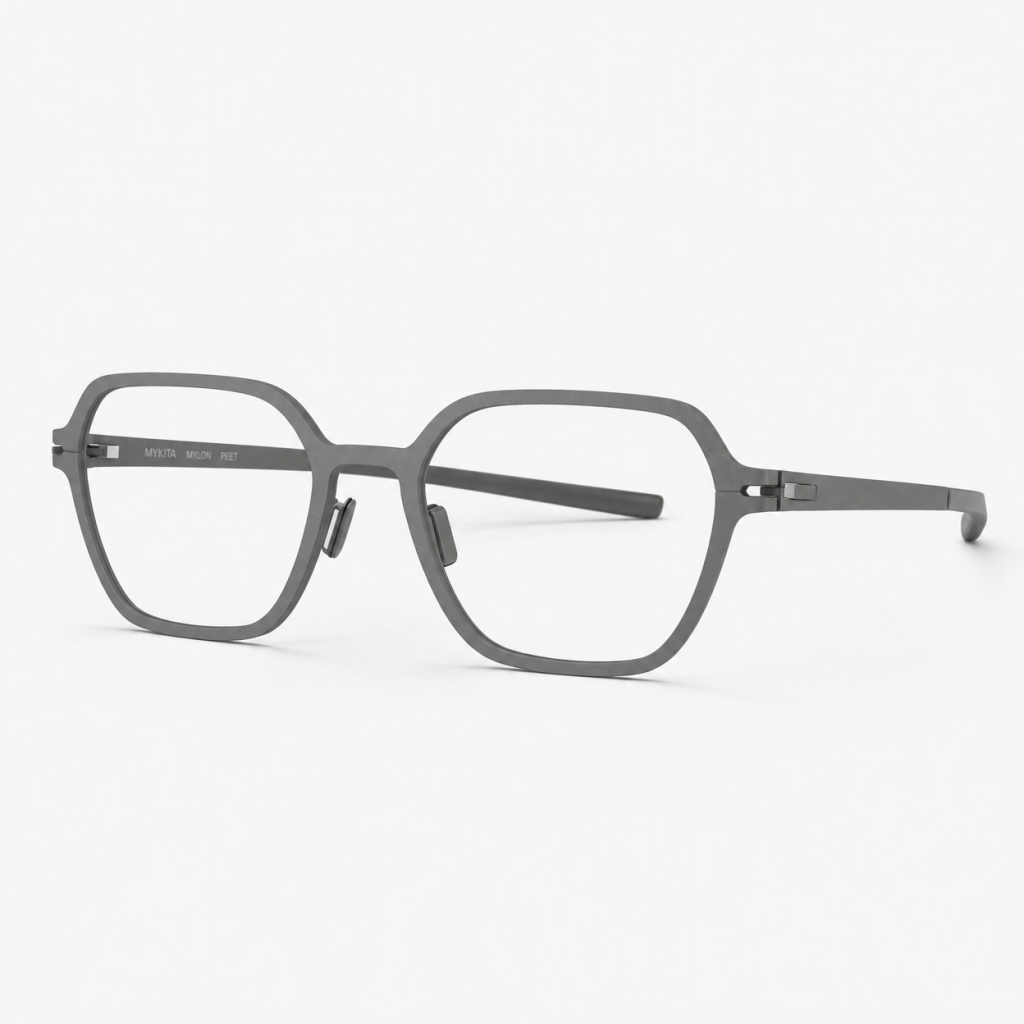
The Mykita Mylon Peet frame design exploits the geometric freedom enabled by SLS manufacturing to create a distinctive angular aesthetic that would be extremely difficult to achieve through conventional manufacturing. The Peet’s characteristic cross-bar bridge—a structural element that spans the nose bridge in a distinctive angular form—is a design detail that can only be economically produced through additive manufacturing, as its complex geometry would require multiple complex machining operations or precision molding at considerable cost.
This unique bridge is a signature element that sets the Peet apart. The temples of the Peet are fabricated from flat stainless steel sheet using Mykita’s signature manufacturing approach, which gives them a distinctive visual character that complements the angular geometry of the Mylon front. The combination of matte or semi-gloss Mylon body with flat steel temples creates a visually interesting material contrast that reinforces the frame’s contemporary, design-forward character. This interplay of textures and materials is a hallmark of Mykita’s design language, resulting in a frame that is as much a work of art as it is a functional optical device.
Available Finishes and Color Options
Mylon frames are available in a range of surface finishes that exploit the aesthetic possibilities of the SLS process. Solid matte colors—including matte black, matte white, matte grey, and matte navy—provide a clean, sophisticated appearance that emphasizes the frame’s architectural geometry. These colors are deep and rich, adding to the premium feel. Semi-translucent options allow a glimpse of the material’s internal structure, creating a depth effect that cannot be achieved with conventional opaque acetate. This gives the frame a unique, almost otherworldly quality.
The SLS process allows color to be fully integrated throughout the material thickness rather than being applied as a surface coating, meaning the frame’s color remains consistent even if the surface is scratched or worn. This is a significant durability advantage over painted or coated frames. Whether you prefer a classic, understated look or something more avant-garde, there is a Mylon Peet finish to suit your style. The color becomes part of the material itself, ensuring lasting beauty.
Prescription Lens Compatibility and Fitting
The Mykita Mylon Peet accommodates single-vision, bifocal, and progressive prescription lenses within its robust full-rim construction. The Mylon material provides excellent lens retention through its precise, consistently manufactured lens channel, and the material’s stiffness ensures that the lens shape is maintained accurately over time. You can trust that your prescription will be held perfectly in place.
The geometric lens form of the Peet—typically a modified rectangle or hexagon—provides adequate optical area for most prescription types and works well with progressive lens designs that benefit from sufficient vertical depth for both near and distance viewing zones. Your optician will be able to fit the Peet with a wide range of high-quality lenses to meet your specific visual needs. The combination of advanced frame technology and precision optics ensures a superior visual experience. The Peet is not just a design statement; it is a highly capable platform for vision correction.
Sustainability Considerations
The SLS manufacturing process used to produce Mylon frames has several meaningful environmental advantages over conventional eyewear manufacturing. The additive nature of the process minimizes material waste—virtually all the Mylon powder that does not become part of a frame can be recycled and reused in subsequent manufacturing batches. This is a far more sustainable approach than traditional subtractive methods.
The absence of solvents, chemical treatments, and surface coatings reduces the chemical inputs and waste streams associated with acetate frame production. And the digital design-to-production workflow enables distributed manufacturing that can reduce transportation distances compared to centralized conventional manufacturing. For environmentally conscious consumers, the Mylon Peet offers a way to enjoy high-quality, stylish eyewear with a reduced ecological footprint. It is a choice that is kind to both your face and the planet.
Conclusion: A Glimpse into Tomorrow’s Eyewear
The Mykita Mylon Peet represents a genuine advance in eyewear manufacturing that delivers real benefits to the wearer: exceptional lightweight comfort, superior durability, total hypoallergenicity, and a distinctive design aesthetic that cannot be achieved through conventional production methods.
For wearers who value innovation as much as aesthetics and seek eyewear that reflects a forward-looking sensibility rather than a reverence for established conventions, the Peet is one of the most compelling choices in the premium prescription frame market. It is a conversation starter, a piece of advanced technology, and a supremely comfortable pair of glasses all in one. The Mylon Peet is not just an accessory; it is a statement about the future of design and the limitless possibilities of technology.
